All things Internet allow people to hide behind a screen name and say things they wouldn't say in public.
a blog on the opinions and strategies used in the X's and O's of NCAA Football series by Tiburon/EA Sports.
Sunday, August 26, 2012
Lets Talk Etiquette
So uncalled for....
Tuesday, August 21, 2012
*Deep Deep Sigh*
So a new season of EA's NCAA Football is here. The Flexbone offense has been nerfed, HARD. The toss is basically a stretch play and leaving you with nothing to burn people with when they blitz their inside linebackers.
Ho-hum. I've resorted to using the Spread offense. I found a couple of good schemes from Shotgun Split Offset and Shotgun Offset Wk on Youtube and created my own from 4WR Trio. Adapt and Overcome.
Schemes and Blitzes are in anybody who's still following this blogs future.
Until then,
Option and Prosper.
Monday, January 23, 2012
Paul Johnson "If/Then" Playcalling system
Edit: I owe a big debt of gratitude to Duece over at Footballislife.blogspot.com If it wasnt for his post on the same subject, I would've never done this write up.
Paul Johnsons System is all built around running the Triple Option. To get proficient at it You must practice it against all front and know what fronts you cant run it against and what your opponent can do to take that away. The other plays are used as counters to keep the defense vanilla. Im not going to get all into detail like I usually would. But if you have any questions, feel free to ask. I've tested this out for about 8-9 months as I've been working on this since right before the end of '11's season. I've been fairly successful with the system minus a couple of hiccups in my decision of playcalling and dealing with the 1-5-5 . Give it a try and we can discuss it and tweak it for all. NOTE: This is just a guideline for how to use the offense. Should be noted also that playcalling is a art and this is just a tool to help you get out of binds that you may face online.
vs 8man Front
- Utilize the Twins Over, Split Wing Z/X, Tackle Over or Trips
vs Force players on the LOS
-Run Close and Split Z/X to get Better Blocking on the Perimeter
Vs 3-3-5
- See 8man front
After you've done that:
If the free safety is in the box and nobody from the defense goes over to the unbalanced side, attack where the defense has fewer numbers.
If the defense takes somebody over, attack the side from where the defender was taken.
Also dont forget the personel packages This allows your opponent to see 3HB and 2WRs on the field most of the time and allows you to play a chess game with them so they'll never know where they'll line up.
Playcalling
Like I said earlier, The key play is the Triple and all the other plays are a counter to what the defense does against that. Now the general real life rules for wether you call Midline or Triple is depending on the defensive line technique, or where the linemen line up.
The real life rule is that if you have a 2 or 3tech playside (PS) run midline, If you dont have 2 or 3 tech playside run Triple. Im not going to tell you not to do it. But if you do decide to run the triple, I reccomend using the rule of watching to see if the MLB blitzes (keep) or not (Give).
Run Double Option if:
TNT or Bear Front
DT/NT is wrecking havoc and getting into the backfield fast
The opp. is concentrating on taking away the Dive.
Run FB Dive/Sting if:
PSLB is scraping outside
Opp is usering the DE to give a cloudy read
Two 1techs and a MLB aligned over the Center
Run Rocket Toss if:
TNT or Bear Front
Stunting toward inside gaps
PSILB is blitzing A or B gaps
Force Player on the LOS
DE Blitzing the Dive
Run Counter Option (FB Load Option) or WB Misdirection If:
Opp is usering the BSLB and blitzing the BS A gap
Opp is usering LB and flowing hard to the tail motion
Run Option Passes if:
Opp is usering any Safety and flowing fast to the tail motion
Monday, September 19, 2011
Open Letter from "A Dying Vine
If you guys are wondering why I havent updated the blog. Truthfully, Some of the problems with 12 have pushed me away from the game to where I havent played in about 2 months. The letter below, from the moderating staff of Ncaastrategies.com, signifies some of my concerns and sentiments. Please read and pass along.
In the wake of Patch #2 for NCAA 12, the moderating staff and community at Utopia wish to express our displeasure and frustration in an open letter to EA and the so called “Game Changers” and “Community Sites.” EA’s NCAA football series served as the catalyst for this site in 2003, and though the Utopia community has evolved to the point that it is no longer centered on EA’s game, we still have a common wish for a quality college football video game. This franchise was once unanimously recognized as one of the most enjoyable and innovative sports games on the market, but has now fallen to such depths that virtually everywhere you look, more and more people on forums all across the internet are expressing extreme frustration and displeasure with both the game and the company that makes it. We see three obvious factors that have contributed to the environment that allows such an abject failure of a video game to be released (with good reviews, no less); exclusivity limiting competition, EA’s patching methodology, and the “Game Changers” marketing scheme which helps to fracture the community and marginalize legitimate concerns about the game.
Problems caused by exclusivity:
Due to the fact that EA has purchased the exclusive rights to the NFL and NCAA football games, they have effectively pushed out all competition from football gaming. This means that they can release bug-filled games without the risk of losing customers who would buy a more polished football game if one were available. One need look no further than the recent failure of EA’s basketball game to see the effect of competition on sub-par and bug filled games. The Madden and NCAA series have been plagued with bugs similar to those that caused NBA Live to be shelved, but without competition the games will continue to be developed with as little effort as possible. The results of the lack of competition speak for themselves. The NCAA series has devolved to the point that gamers can expect even the heavily marketed new features to be completely non-functioning at launch.
For instance, NCAA ’09 touted a new roster share feature that was supposed to allow people to create custom rosters and easily share them with their friends. Unfortunately, the roster editor feature of the game contained a glitch so that once a certain number of players were edited, teams started completely disappearing from the game. On top of that, “Wide Open Gameplay” (the tagline for that year) translated into “No Defense At All”, and the game quickly turned into a complete joke as it was nearly impossible to stop anybody on defense. On NCAA ’10, the game was released with sliders that did not work (i.e. they had no impact on gameplay at all), with rosters that were clearly flawed, and with a new “run commit” feature that was so overpowered it virtually destroyed any gameplay balance (particularly for online play). NCAA 11 touted the new “locomotion system, which effectively broke zone defense, and new web based dynasty interfaces like the “Dynasty Wire,” which turned out to be incredibly buggy (frequently crashed or displayed the wrong information) and is still listed as “Beta” on the website.
This year, one of the most heavily marketed new features in NCAA12 was custom playbooks, something Utopians have been asking for since the feature was dropped with the move to next-gen systems. As many have come to expect from EA, the custom playbooks feature was completely broken at launch. It contained a glitch which would cause the playcall screen to go blank and would result in players standing around in a huddle over the football rather than lining up in the correct formation. In addition to the custom playbook glitch, the new custom conferences feature was also broken at launch, containing massive scheduling errors that rendered it unusable. In addition to problems with new features, there were also numerous instability problems that caused the game to freeze or crash, as well as several glitches that affected online dynasty mode, such as dynasties not being able to be advanced properly and wins not being correctly recorded. At this point, the game is so bug filled that you are lucky to finish a game without a crash or disconnection. Even if you do finish the game, the result may have been recorded incorrectly, making your efforts futile. It is like clockwork; every new feature will be completely broken at launch and features that worked in the past will have new and crippling bugs.
We acknowledge that all video games are released with some bugs, but we feel that the lack of competition due to exclusivity has allowed EA to release football games that have more numerous and game-killing bugs than any other title. NCAA12 is the least stable console game that we have ever played. If EA had true competition in the football gaming world, they would be forced to either shelve the game, like NBA Live, or go back to the drawing board and dedicate more resources to releasing a quality game, like the FIFA series.
Problems Caused by EA’s Patching Methodology:
In general, the ability to patch games has been both a blessing and a curse for gamers. While a good patch can save a game that would be otherwise derailed by a small bug, it also allows developers to release games that are basically unfinished, counting on patches to tie up all the loose ends. Nowhere is this practice more prevalent than in sports games, with their rushed yearly development cycle.
With the NCAA series, EA manages to take the “release an incomplete game and patch it” model to an incredible new low. Not only do they release obviously unfinished games, but in an effort to patch problems, they introduce new and bigger problems. For instance, last year EA released a patch that was supposed to address some problems with defensive AI and overpowered man to man coverage, and it instead resulted in a new glitch were the QB could pump fake backwards (towards his own goal line), and cause all of the defenders to immediately abandon their assignments and run towards the line of scrimmage.
While there is a long, well documented history of these issues, NCAA12 has taken things to a completely different level. This year, after waiting for nearly two months, EA released a patch that was supposed to correct some of the problems with custom playbooks, online dynasties and system stability. Producer Ben Haumiller closed his blog about the title 2 update with “Thank you again for your patience for the arrival of this second Title Update. I trust you will find that it has been well worth the wait.” To put it bluntly, Ben, It was not “worth the wait.” The patch not only failed to fix the majority of the problems it claimed to fix, but it also caused new problems that affected the no-huddle (a prominent feature for NCAA 11) , completely removed some formations from the game, and caused a host of new issues with the few custom playbooks and online dynasties that had the good fortune to work before the patch. Not only did EA release an extremely flawed product for sale at retail in July, but it took almost 2 months to release a patch, and the patch turned out to cause numerous new problems. At this point, it is obvious that the development team for NCAA football cannot even patch their own game without introducing a cornucopia of new glitches and bugs.
Problems caused by EA hijacking “The Community.”
Over the past few years EA has gone to great lengths to improve their faltering reputation with “The NCAA Community.” Whether it came in the form of sending EA representatives to forums, the “Community Leaders” program, or the Game Changers” program; EA has shown that they value having a positive image in “The NCAA Community.” While this all sounds great, we find their efforts to be entirely disingenuous.
Before they even try to reach out to “The NCAA Community,” EA attempts to define “The NCAA Community” in a way that eliminates those who are openly critical of their product. For instance, Utopia is notably absent from EA’s list of “Community Sites,” despite the fact that we are the largest NCAA specific community. The only interaction we’ve had with EA this year was a Cease and Desist letter in response to our April Fool’s prank, proving that they not only read the site, but they also did not find our prank nearly as funny as we did (in retrospect, our April Fools descriptions of the game were actually far more accurate than the glowing reviews found on other sites). We acknowledge that EA attempts to avoid interaction with us because we are uncouth, drunk, and/or overly hostile; but that doesn’t mean we aren’t part of the community!
We also aren’t the only ones to be excluded from EA’s community program. Several other critical community members, including those who belong to TheSimStandard YouTube group (many of whom have provided incredibly detailed documentation to show problems with the game and ways to solve them) are also shunned by EA. This, despite the fact that they reach far more people than many of the “Community” sites that are included. For example, videos uploaded by TheSimStandard channel contributors have combined for a total of 713,955 views and they have well over 20,000 subscribers, while several of the sites that are included in the program appear to reach fewer than 100 members and are rarely updated with new NCAA related content. The simple fact is that EA has systematically worked to prevent anybody who is openly critical of their game from receiving any official recognition for their efforts. Instead, they choose to define “The community” as those sites, regardless of size/exposure, who will toe the EA company line.
The “Game Changers” program, much like the “Community Leaders” program before it, is a complete farce. As much as EA talks about incorporating community feedback into the game, it is increasingly evident that EA does nothing of the sort, and these programs are simply an extension of EA’s marketing strategy. Simply put, we do not see any substantial in-game results from the “Game Changers” program, but we do consistently see a ton of pre-release hype along with glowing reviews. To be fair, we do not fault the “Game Changers” in this. We truly believe that most of them have the best intentions and that they have put in a lot of work attempting to make this a better game. The problem lies entirely in the fact that EA simply can’t (or won’t) make most of the changes suggested by the “Game Changers.” The game engine itself is so archaic, bug-filled, and ad-hoc at this point that most of the common and recurring issues cannot be solved without a significant commitment of resources from EA, which is a commitment they won’t make. Instead, EA will take input from the game changers and promise grandiose changes like “Custom Playbooks” and “Pattern Matching Coverage,” while the actual implementation of those “features” will be nothing but ham-fisted tweaks to an aging game.
Beyond being simply ineffective, we believe that the “Game Changers” and other EA sponsored “Community” programs fracture the true gaming community and create a divisive environment that allows EA to release such buggy games without the proper amount of community outcry. This is due to the fact that EA places the “Game Changers” in the unenviable position of answering to angry gamers for all of EA’s fumbles. These “Game Changers” serve as the only link between the average frustrated gamer and the NCAA football developers. They become de-facto customer service representatives, without the paycheck. The frustrated gamers and the frustrated “Game Changers,” who now must put up with misguided personal attacks, end up divided. Instead of directing the frustrations and anger at the proper target, the community bickers between themselves.
We are therefore extending an olive branch to the “Game Changers.” We don’t hate you, we just lash out in frustration because EA has forced you to play customer service representative for a terrible product. We even apologize for directing our anger and frustrations at you, when EA is clearly the culprit. Please join us in calling EA out for the incredible levels of failure that are present in NCAA12 and Patch #2.
Signed-
The Utopia moderating staff and frustrated NCAA gamers elsewhere
Saturday, May 28, 2011
Attacking the 3-3-5 and other 8-man fronts from the Flexbone
The Biggest Question lately between the small group of Flexbone guys is how to handle the 3-3-5. I’ve had to go through my Flexbone Clinic Notes and find out how Paul Johnson or anybody from his coaching tree handle the Odd Stack
Vs. the Odd Stack (3-3-5/3-5-3)
Step 1 - Get into (Twins) Over, Trips, or Heavy (Split X or Z and Goal Line). This is done versus all eight-man front teams to see if they bring someone over from the backside to the play side. In attacking the Odd Stack, you must get into Trips/Over/Heavy to make the defense declare their backers or coverage (zone or man).
Step 2 - Then, see where the Free Safety is aligned.
If the free safety is on the midline (aligned over the center) and nobody goes over to the Trips/Over/Heavy side, run triple to the Trips/Over/Heavy side.
If the defense takes someone from the backside to the play side, or the defense takes the free safety over, attack the side from where he is taken—away from the Trips/Over/Heavy side.
Important note: When running the Triple Option vs the stack, You need to read the Linebacker and not the defensive end or SS.
Basic Play Calling guide when running the Triple v. Odd Stack or 8 man fronts.
-FS or play side corner make tackle on Triple = run Option Pass
-If Invert/Overhang/Spur makes tackle on dive or quarterback = Over, Triple Option Blast or Double Option Solid to weak side.
-Vs. Bear = Over/Heavy Double Option to the weak side
-Nose or Mike tackle the Dive = Double Option
-Backside Linebacker tackles the Dive = Counter Option (Trap Option or FB Load with Counter motion
-Playside Linebacker blitzes inside = Rocket Toss
Next up play selection
Monday, January 24, 2011
Heading back stateside
To those that know me, know that Im in the Navy and currently stationed overseas in the country of Bahrain. On the 27th I'll be heading back stateside, transfering to Gulfport, Mississippi. With that being said, expect a lot more play breakdowns (as Im currently working on coverage breakdown, to better explain when and how to uses some of your base coverages) and videos on some of the stuff I explain.
3 days, guys.... 3 days!
Saturday, January 22, 2011
Split Field Coverage Pt. 3: Solo and Special
Sorry for the long delay guys.
So far we've talked about handling Trips from the 2-Read (Cover 2 Robber) and how to handle the 2x2 formations from your base 4-2-5 sets. Today I'll give you suggestions on how to handle 3x1 with a solo call and 5 wide sets all from the base 4-2-5 sets
Cover Blue-Solo
“Solo” is a tag that is used verse 3x1 sets that is played on the away side.
PLAY: 4-2-5 Cover 4 (Same as the Cover BLUE)
Adjustments:
So far we've talked about handling Trips from the 2-Read (Cover 2 Robber) and how to handle the 2x2 formations from your base 4-2-5 sets. Today I'll give you suggestions on how to handle 3x1 with a solo call and 5 wide sets all from the base 4-2-5 sets
Cover Blue-Solo
“Solo” is a tag that is used verse 3x1 sets that is played on the away side.
This tag puts your Away-side corner on an island in man to man coverage, The Read-side continues to play their assigned coverage, 2 “Robber”. The WS safety and the Read-side Lber have the responsibility of the #3 WR. If he tries to run a divider route, the Lber should bump him and redirect him off his route and the WS will catch him and take him vertical. This also allows you to either blitz or set the MLB in M/M on the HB. Another example is seen below.
Adjustments:
- Set the Away-side CB in M/M coverage over the single away-side WR
- Spread the safeties
Special
Special is probably the preferred call against 5 wide 3x2 sets. The FS will cover the Trips side, He and the SS will play BLUE (Squats and halfs) over the #2 and #3 WRs with the Away-side playing the same coverage. FS and Corners have deep and the SSs have the Curl/Flat zones. Read-side Backer has the QB on any draw play. This also leaves everybody in perfect position for run support in case of a Jet Sweep to the outside.
PLAY: 4-2-5 Cover 3
Adjustments:- set the Read-side CB in M/M coverage over the #1 WR.
- Manually cover any deep routes by the #2 or #3 WRs with the FS.
Thursday, November 11, 2010
4-2-5 Split Field Coverage Pt.2
Cover 2-Blue is a Split Field coverage, that is mostly employed by 4-2-5 teams vs Singleback sets. Not to say that you couldn't use a play like 2 “ROBBER” vs a Singleback look, but it stresses the Awayside linebacker.
As Oneback has already explained. The front calls are completely separate from the coverage so this is adaptable from the 4-2-5, to the Nickel package.
They hyphenated call means that the secondary will be playing two different types of coverage to their respective halves of the field. The read side, or the side of the passing strength is playing 2, which is the Robber coverage. The Away side is playing BLUE coverage.
Cover 2 is basically The ROBBER coverage cut in half. This is the side that You’ll have the FS reading the #2
Blue is a combo coverage using the CB and the WS on the away side #2. The Corner has the Curl/Flat while the WS has anything deep and the Mike comes over to help for the intermediate routes.
So basically this s a double ROBBER play, thats great against Singleback/Pro/2x2 Spread passing.
Building this play is easy and only takes a few adjustments:
Play: 4-2-5 Cover 4
Make sure the side that you declare as the strength the readside LBr is in the Hook Zone. This is the side that you’ll be usering the FS.
Adjustments:
- Awayside CB in to a Flat Zone
Saturday, October 16, 2010
4-2-5 Split Field Coverage Pt.1
Oneback has already explained how to use the "ROBBER" scheme to perfection. What I want to show you is how to adapt this to 2x2 sets and 3x1 sets and introduce you to SPLIT FIELD COVERAGE, a schemes that TCU and other 4-2-5 teams use.
TCU teaches their secondary to divide their formations down the middle of the field and after you do that to each side there’s only 3 Formations that the offense can give you.
FORMATIONS
(with the addition of Quads that adds a new wrinkle which I’ll get to in a separate post)
4-2-5 Cover 3 will be your base play just as Oneback stated in his Robber description. The Read side, will of course, be the Trips side. Vs any 3x1 formation you want to shift your LB over towards the trips side to wall off the first thing that comes inside. You’ll also want to Shift the coverage to the Trips side. This gives you close variation to Quarter/Quarter/Half Coverage. You’ll also want to take that read side SS and put him a Buzz zone to handle everything outside the hash and it keeps him in place to handle run support.
In this coverage I personally user the FS and run the same Robber Rules with him and try to handle anything that threatens the inside. The SS in the Buzz zone handles anything that goes to the outside of the hash leaving the C to continue his dropback to handle anything deep. With the FS you, seriously, have to follow the ROBBER rules or the Middle is open. Remember that if the inner most reciever runs a shallow the responsibilty for him is passed off to the LBers in hook zones, and you have to gain depth with the FS and look for the backside post.
Weakness:
Screens
Summary
Base Play: 4-2-5 Cover 3
Adjustments:
(H/t to Brophyfootball.blogspot and RunCODHit.blogspot for inspiring this and the next series of updates)
TCU teaches their secondary to divide their formations down the middle of the field and after you do that to each side there’s only 3 Formations that the offense can give you.
FORMATIONS
- Pro - TE and WR to one side
- Twins - Two WRs to one side
- Trips variations
(with the addition of Quads that adds a new wrinkle which I’ll get to in a separate post)
4-2-5 Cover 3 will be your base play just as Oneback stated in his Robber description. The Read side, will of course, be the Trips side. Vs any 3x1 formation you want to shift your LB over towards the trips side to wall off the first thing that comes inside. You’ll also want to Shift the coverage to the Trips side. This gives you close variation to Quarter/Quarter/Half Coverage. You’ll also want to take that read side SS and put him a Buzz zone to handle everything outside the hash and it keeps him in place to handle run support.
In this coverage I personally user the FS and run the same Robber Rules with him and try to handle anything that threatens the inside. The SS in the Buzz zone handles anything that goes to the outside of the hash leaving the C to continue his dropback to handle anything deep. With the FS you, seriously, have to follow the ROBBER rules or the Middle is open. Remember that if the inner most reciever runs a shallow the responsibilty for him is passed off to the LBers in hook zones, and you have to gain depth with the FS and look for the backside post.
Weakness:
Screens
Summary
Base Play: 4-2-5 Cover 3
Adjustments:
- Shift LBs and Coverage toward the Trips side.
- Hot Route the Trips side safety to Buzz Zone.
- Align FS over the inside most threat
Proper Alignment is very important vs trips sets.
(H/t to Brophyfootball.blogspot and RunCODHit.blogspot for inspiring this and the next series of updates)
Sunday, October 3, 2010
How To Play "ROBBER" Coverage
Thanks to Oneback over at Utopia, I didn't know anything about Robber Coverage until he explained to me how to run it, I've had a massive hard-on for the coverage every since. Be it Cover 1 Robber, 2 Deep Robber or the Hook Zone in a Cover 3 play. This has revolutionized the way I play defense.
Pre-snap the free safety will align to the passing strength of the formation, if #2 is a tight end he will align on the outside shoulder and eight yards deep, if #2 is a wide receiver he will align on the outside shoulder of the offensive tackle and eight yards deep.
After the snap he will read the quarterback for run/pass key, once he reads pass he will focus on #2s route.
If #2 runs a vertical route you will have him in man-to-man coverage to the inside, depending on the route of #1 the free safety may have outside help by the cornerback.
If #2 runs an arrow or quick out route the free safety must widen with #2 while keying #1.
The free safety must get underneath #1 and be alert for a pass to rob the pass.
If at the snap of the ball #2 runs a shallow cross the free safety must open to #1 gaining depth and width.
Be alert to a backside post route by the backside #1 or a seam by the backside #2.
If there is no backside deep threat, rob strong side #1.
If #2 runs a deep out key #1.
Alert post or deep outside route by #1, play underneath #1 with corner over the top to rob the pass.
If #2 runs a dig route in real life the free safety would jump the route to the inside and attempt to intercept the pass. However, due to the fact linebackers in coverage have the ability to sense routes being run behind them I typically fall back into deep middle coverage.
Look to the strong side #1 to ensure he is not running a post route then look to the backside for a deep threat.
With a #2 dig route the free safety will typically play inside of the deep threat to either side with the corner to the outside.
The ability to play effective robber coverage will force the offense to throw deep to the outside or underneath as the defense will take away the easier throws over the middle that most offenses look to complete.
Wednesday, September 22, 2010
TCU's Tite Short Smoke 0 Blitz
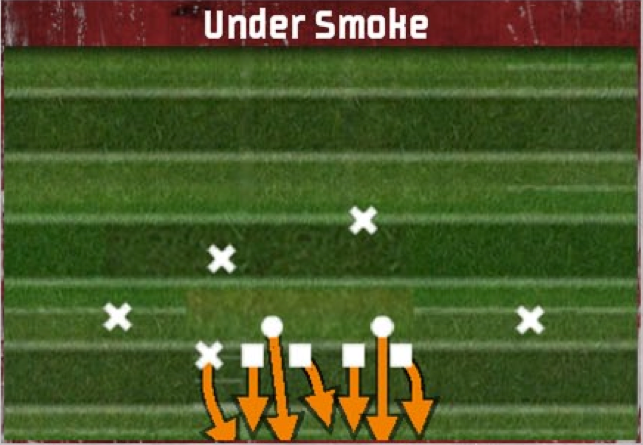
Formation: 425 Under (if the ball is on the left hash)
425 Over (if on the right hash)
Base Play: Crash Gold
This is a awesome pressure play to use when the ball is on the hash, a good change up play since most 4-2-5 like to use zones because of deficiencies with man coverage. If you're familiar with my philosophy on how to use the 4-2-5, I dont use the base plays vs Trips 4 and 5 wide unless I chose to dail up some type of blitz. If you call this play, and your opponent audibles into a Trips play, its a pretty good idea to have Nickle Strong Cover 1 "Robber' in your audibles.
Play Setup:
Again, this is a hash blitz. The "Tite" Call is telling you to set your 3 tech DT away from the TE, hence, the Under/Over formations. The Over Formation gives you a 1 Tech Nose Guard and a 3 Tech DT, while the Under is the exact opposite. The "Short Smoke" Call, tells your SS/OLB that he's blitzing from the boundary.
Optional Adjustments:
- Back off coverage so to not get beat by the deep bomb
- Set the blitzing ILB to Spy as this helps against the inside run and doesnt leave a huge cutback lane that can open if you leave him set to blitz.
Thursday, August 26, 2010
Bear Front Defenses
While many of you are aware of the Bear Front defenses in you defensive playbooks, the majority don't use it because of your lack of understanding of the scheme behind it.Every defensive package should have some sort of Bear Front in its package it is set up. The 4-2-5 and 3-3-5 have a version based off the 46 (pronounced “forty-six” not “Four-Six)Defense that was designed in the early 1980s by Buddy Ryan with the Chicago Bears. Most folks know that – and hence, the nickname, “Bear” Defense. It was the defense of the dominant 1985 Bears team. This is also the front used in Arizona’s “Desert Swarm defense back in the day and the same defense that Army is using today (A mixture of the 3-4 and 3-3-5).
The defense has its basis in the old 5-2 Double Eagle front and is easy to stem in and out of from your base defenses. It is an 8-man, run-stopping front that works well with man coverages and with Cover 3.
Alignment
The alignment of the Bear Defense revolves around the 3-0-3 alignment in the middle. This means we have a Defensive Lineman aligned on the outside shoulder of each of the Guards, and a head up Nose Guard. The biggest advantage of this front is its almost impossible to create double teams, especially on your Nose Guard.
The weak side Defensive End stays in a 5-Technique. On the strong side, one Linebacker/SS is going to walk up on the inside foot of the Tight End while another Linebacker or Safety is going to walk up on the outside foot of the Tight End. Whoever is doing this is going to be based on the Defensive playbook, so don’t get caught up in the letters.
Run Fits
There’s no better front for stopping the run than the Bear. The 3-0-3 techniques are great for stuffing runs up the middle and forces your opponent to take runs to the outside. This, by design, the contain players on the perimeter will make or break if this defense works for you or not. If they don't keep a proper contain on the perimeter you’re going to be open to the outside run play all day, so you definately have to be careful with your play selection.
There are all sorts of Run fits in these playbooks. Cover 1 Plug from the 46 Bear, Storm Read from the 3-3-5 Bear, and the MLB Blitz from the 4-2-5 Bear.
Coverages
As mentioned, the coverage for the Bear Front Defense is mostly going to be Cover 0, Cover 1 or Cover 3 – which should be the case with any 8-man front defense, unless you’re running the 3-3-5 Bear version which is the only Bear Front that offers a Cover 2 “Robber” (which you already know Im a fan of) in the Spy 2 Blitz play and my personal opinion is that it should be in every bear front scheme. )That’s going to be the basic look.
You can get creative with your coverages in any defensive front, but the reality is, you are limited in coverages with the 46 Defense. Bear defense coverages are pretty well limited to Cover 0, Cover 1, and Cover 3.
Cover 1
The primary Bear Defense coverage is the Cover 1, with man coverage and one safety helping over the top. This allows a 4 to 5 man rush on the QB.
4-2-5 offers 3 versions of Cover 1. One that I like to play with is QB contain. Sometimes I decide to make adjustments to this play (IE Canceling out the contain) but I usually get a good amount of pressure with it on verses a user that knows how to use the option playbooks.
CB Fire 1 is a great play to use on passing downs when the ball is on the hash. I personally like to send corner blitzes on from the boundary (short) side of the field. Many people think they are useless plays and twice as many never expect them.
Cover 0
The next coverage for the Bear Defense is a Cover 0, Man Coverage with no help over top and a 6 man rush. All 6 players lined up on the line will rush, with the Free Safety taking the Tight End or the Halfback. If you've shown a lot of Zone plays from the Bear, try mixing in some Cover 0
4-2-5 plays:
MLB Blitz and Strong Safety Fire
3-3-5 plays:
Monster Green, Fire Green and Middle Plug
Cover 3
Finally, the Cover 3 is the natural fit for zone coverage in the Bear Defense.
The Free Safety and the two Corners handle the deep 1/3′s, which is pretty standard in Cover 3.
You have the option of making this a 4 under, 3 deep coverage with a 4 man rush or a 3 under, 3 deep coverage more closely associated with Fire Zone blitzes and 5 man pressure. How you want to create the 3 under, 3 deep (or any zone coverage out of the Bear Defense) is going to depend on your personnel. You may not have an End who can drop off, so you’d need to adapt.
Thoughts on Coverages
The Bear Defense is an attack-style defense. It is for causing havoc in the backfield. Man coverage is best for quick throws, because your guys are playing closer to the receivers.
If you’re going to run the Bear Defense, you need to be forcing quick throws with heavy pressure from the guys on the defensive front.
Strengthening Your Bear Front
I suggest building a stronger line for something like this by Formation Subbing. Making sure that your largest and best tackle is at Nose and, depending on what base defense your using, that your 3tech players are Tackles too. I also experimented with adding a 4-4 and 3-5-3 personnel to these packages in these playbook and had pretty good results. The fact that the Bear coverage scheme is mostly Man coverage, the only plays you have to be careful of is Cover 2 Man when using the same formation subs.
(H/t to DrB at http://www.shakinthesouthland.com/ and Coach Joe Danienl at http://www.football-defense.com/)
Tuesday, August 10, 2010
Spread Offense Manual from 09
Been going through this recently. Very well thought out and the principles still hold true...
Spread Option Manual v 1.1
Friday, August 6, 2010
Employing TCU's Bullets Thunder 0 Cop Blitz
I’ve been doing a lot of reading on the 4-2-5/4-4 defense, defenses in general. I recently ran across a post over at Blitzolgy about TCU’s Bullets Thunder 0 Cop Concept. Oneback has already described in his guide the basic calls TCU uses on defense out of their 4-2-5:
BULLETS - linebackers (Mike / Sam) blitzes
SMOKES - Safeties (Strong/Weak) edge blitzes
DOGS - Safeties & linebacker blitzes

The Bullets call, that involves the blitzing of both inside LBs through they're respective gaps, A of the Sam backer and B for the Mac backer. You can also send them into different gaps if you see fit. I.E.: The call “BULLETS A” would call for the Linebackers to blitz their respective “A” Gaps.

The next call is Thunder which tells the the Safety to the TE side that he’ll be blitzing from the outside. The next part of the call is 0 Cop. 0 is for the coverage, meaning all out man coverage with no safety help and the Cop Tag is a call used to tell the DE that he’ll have the TE in man to man coveage. TCU has very athletic DEs that allow them to be this creative on their blitzes. If you dont have athletic DEs I suggest using the LB Pass Rush package.

You can create this concept out of a number of looks from the 4-2-5, 4-3 and 4-4. I like to use for this concept out of Nickel Strong - Under Smoke.
Tuesday, July 6, 2010
Its been a long time.
I'll have some new stuff coming in the next couple of days. A large one dealing with Cover 1 "ROBBER" out of a number of different formations. BEST COVERAGE IN FOOTBALL.
Stay tuned,
Tez
Stay tuned,
Tez
Friday, May 28, 2010
Gap Control from the 3-3-5
With the reintroduction of Formation Subs into the next installment of the NCAA football series. I’ve been recently intrigued with the 3-5-3 defense. Its been the only thing I’ve been researching lately, seeing how I’ve exhausted every outlet trying to find something on the 4-4 “G” defense.
The 3-5 (or 3-3 Stack) is like the 3-4 on steroids. It gives you the ability to leave your opponent clueless on where the pass rush is coming from with 3 down linemen. You s necessarily need a “Jack” Linebacker, as the 3-4 employs. I like to employ a the first string SS and the other a OLB/SS hybrid, or a larger Safety type. Same theory as the “Jack” linebacker that is a DE/OLB thats a pure pass rusher that can play either standing up or with a hand in the dirt.
When I used the 3-3-5 in 10 the hardest thing for me was to stop the run. Luckily I found some good run fits verses people who try to bring the power run game to try to rip the 3-man line.
Gaining and Maintaining Gap Control
Typically, a 3-front defense is a two gap type of scheme. What that means is you're required to read and react to close the gap to the playside. You have keys in the offense, most notably the offensive linemen in front of you. If a guard pulls, he's going to bring you to the football the majority of the time. If the offensive lineman pass sets, you're probably going to rush the QB (unless a blitz is on, then responsibility CAN change to an occupier role). The truth is, they have to make a read and react. The nose, for example, will attack the center and slide into a gap as a play develops. Some of the best noses don't have to engage and react, they can react at the snap because they see what's going on. They are responsible for both A Gaps technically. In the game the key to improving your gap control is using slant stunts with you Defensive Linemen mixed in with blitzing Linebacker or two.
One Zone Blitz/Run Fit that I love to run is the Crash 3 Play from the Stack alignment.
The adjustment for this play is simple. Only thing you need to do is slant the line to towards the TE and user the blitzing linebacker.
Linebacker Pressures
Gap Pressures: Your LB’s must press the Open Gaps, You must know which gap is going to be vulnerable and blitz that gap with a LB, You can manipulate this by successfully manually blitzing, once your opponent decides to start shifting the line to the side that you’re blitzing from pulling a bait and switch and throwing in some F@G defense into the game should throw them off a bit. You also have to know which gap will be open for the LB. Recruiting wise for this defense your Mike LB is the anchor of your defense and needs to be a Ball Hawk. The defensive line movements and stunts are also important when it comes to the 3-3/3-5’s gap pressures and control. There are only 4 basic DL movements are available: Spread, Pinch, Crash right and Crash left. Adding a blitzing LB will also do wonders for your gap control on your run fits.

In sum, to play great run defense you must attack your assigned gap, shed blockers, pursue the ballcarrier, and make the tackle.This breakdown of gap pressures in the 3-3-5 should help you with understanding the plays that your calling and make you a better play caller.
The 3-5 (or 3-3 Stack) is like the 3-4 on steroids. It gives you the ability to leave your opponent clueless on where the pass rush is coming from with 3 down linemen. You s necessarily need a “Jack” Linebacker, as the 3-4 employs. I like to employ a the first string SS and the other a OLB/SS hybrid, or a larger Safety type. Same theory as the “Jack” linebacker that is a DE/OLB thats a pure pass rusher that can play either standing up or with a hand in the dirt.
When I used the 3-3-5 in 10 the hardest thing for me was to stop the run. Luckily I found some good run fits verses people who try to bring the power run game to try to rip the 3-man line.
Gaining and Maintaining Gap Control
Typically, a 3-front defense is a two gap type of scheme. What that means is you're required to read and react to close the gap to the playside. You have keys in the offense, most notably the offensive linemen in front of you. If a guard pulls, he's going to bring you to the football the majority of the time. If the offensive lineman pass sets, you're probably going to rush the QB (unless a blitz is on, then responsibility CAN change to an occupier role). The truth is, they have to make a read and react. The nose, for example, will attack the center and slide into a gap as a play develops. Some of the best noses don't have to engage and react, they can react at the snap because they see what's going on. They are responsible for both A Gaps technically. In the game the key to improving your gap control is using slant stunts with you Defensive Linemen mixed in with blitzing Linebacker or two.
One Zone Blitz/Run Fit that I love to run is the Crash 3 Play from the Stack alignment.
The adjustment for this play is simple. Only thing you need to do is slant the line to towards the TE and user the blitzing linebacker.
Linebacker Pressures
Gap Pressures: Your LB’s must press the Open Gaps, You must know which gap is going to be vulnerable and blitz that gap with a LB, You can manipulate this by successfully manually blitzing, once your opponent decides to start shifting the line to the side that you’re blitzing from pulling a bait and switch and throwing in some F@G defense into the game should throw them off a bit. You also have to know which gap will be open for the LB. Recruiting wise for this defense your Mike LB is the anchor of your defense and needs to be a Ball Hawk. The defensive line movements and stunts are also important when it comes to the 3-3/3-5’s gap pressures and control. There are only 4 basic DL movements are available: Spread, Pinch, Crash right and Crash left. Adding a blitzing LB will also do wonders for your gap control on your run fits.
In sum, to play great run defense you must attack your assigned gap, shed blockers, pursue the ballcarrier, and make the tackle.This breakdown of gap pressures in the 3-3-5 should help you with understanding the plays that your calling and make you a better play caller.
Monday, May 10, 2010
Defending the Option
A lot of people are having problems defending the Option; be it the I-Form and Flexbone ‘s Triples and Load options, Shotgun ‘s Speed Options and the most dangerous shotgun running play of all, Air Force’s Shotgun Load Option. When NCAA 11 comes out things are not going to get easier (or so we suspect) with the Real Assignment AI blocking, will offer us “Optioneers” a chance to run these plays like they’re run in real life by optioning off the end man on the line of scrimmage or EMLOS. This becomes even more dangerous when plays like the Zone Read and Read Option are actually useful.
There are multiple ways to combat this. The most famous way is playing assignment football
TV analysts often refer to assignment football as a basic need for defenses playing the option. This refers to assigning defenders to each prong of the option. One (or more) defender(s) is assigned to the dive, the QB and the pitch.
Part of the assignment football philosophy is to switch these assignments among defenders in order to put pressure on blocking schemes.
Some common combinations of assignments:
Dive: defensive line
QB: MLB
Pitch: OLB
________________________________________
Dive: MLB and DT
QB: OLB and DE
Pitch: safety
________________________________________
Dive: MLB and defensive line
QB: safety
Pitch: OLB
Besides varying from play-to-play, these assignments will often change from the strong side to the weak side of the offensive formation.
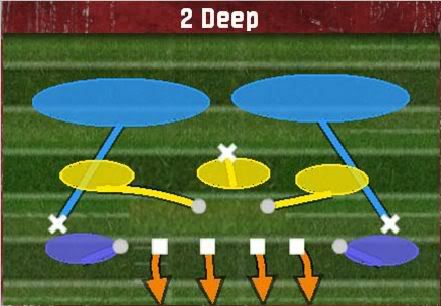
When using this philosophy, prefer the second set up. The D-Line will take the dive with support from the ILBs. The OLBs will take the QB with the Safety taking the Pitch. To build this, I use my base play out of my “G” defense, 4-4 – 2 Deep

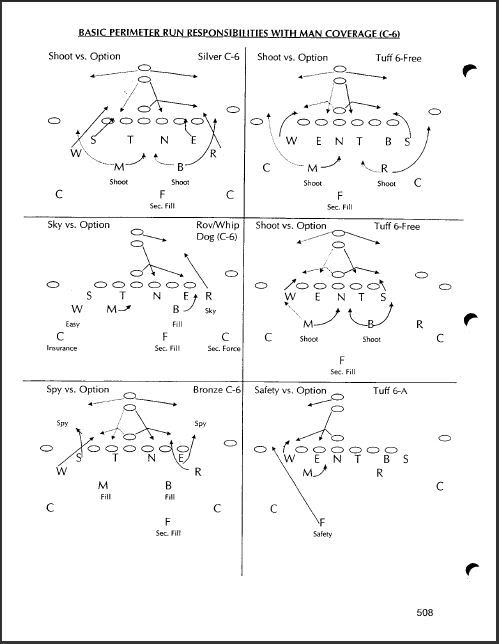
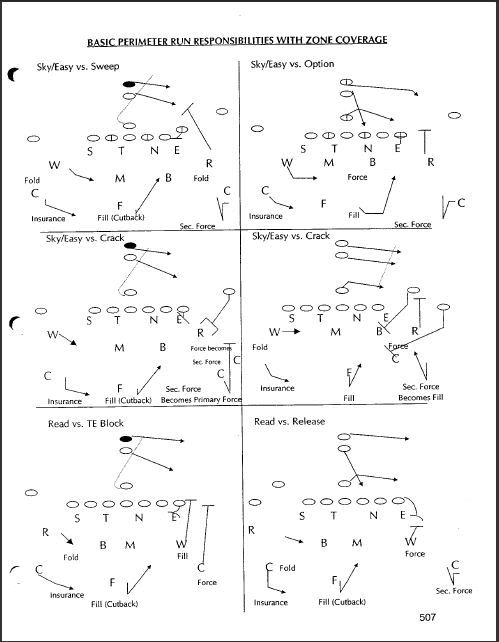
With the Option responsibilities show in the pictures below.


Adjustments
- Set Option Defense to Aggressive to a take the QB*
- Shift the D-line to the Field and Pinch them to handle the dive
- Hot Route OLBs to QB Spy
This play gives you coverage deep coverage, in case of a Option Pass, and puts the OLBs in the “Pitch Alley” You’ll have to user the FS to the play side to cover run support and the FS assignment on the Pitchman. If you played from the Flexbone, you may have seen a lot of your opponents take a Safety and run into the Pitch Alley to disrupt the pitch. Hot routing OLBs to QB Spy will allow them to follow the shadow the QB as he moves behind the line of scrimmage.
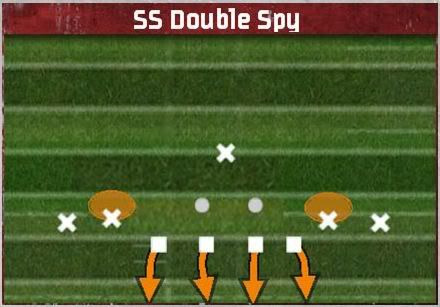
Another play I want to tell you about is a 4-2-5 Normal - SS Double Spy

Adjustments
- None
This play is good vs. your Flexbone - Quick Option/Ace Big – Speed Option types. User the FS to clean up the “pitch alley”. It’s a Cover 0 play, So I wouldn’t use it unless somebody is killing you over and over again with the Ace Big – Speed Option.
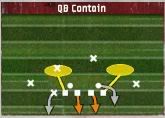
Another way to play the Option is letting the D-Line take the dive with support from the ILB farthest from the play side. If there is no dive the PSLB will play the QB and the OLB/Secondary will take the Pitchman. To build this I use the Nickel Strong – QB Contain play. (This play is also found in all the 4-3 alignments, but is global in the Nickel playbooks.)

Adjustments:
- Show blitz to walk a safety down into the box
- Spread the line
- Crash line in
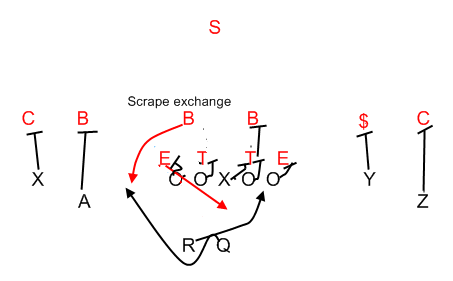
I prefer this set up verse shotgun option teams but it works verses under center option too. What this does is gives you a “Scrape Exchange” a real life technique that teams use verses teams that like to use variations of the Zone Read to go along with your Assignment Philosophy. With this defensive adjustment, the defensive end always crashes for the running back, while the linebacker “scrapes” over to take the quarterback. If the quarterback doesn’t see this, he will pull the ball, thinking he will have an easy lane on the backside, and instead runs straight into the linebacker.

SCRAPE EXCHANGE: PistolxCoach, at the utopia boards is the inspiration for this post as he is the one that gave me the set it up.
Great set ups, and hopefully with these tools you can stop the option.
There are multiple ways to combat this. The most famous way is playing assignment football
TV analysts often refer to assignment football as a basic need for defenses playing the option. This refers to assigning defenders to each prong of the option. One (or more) defender(s) is assigned to the dive, the QB and the pitch.
Part of the assignment football philosophy is to switch these assignments among defenders in order to put pressure on blocking schemes.
Some common combinations of assignments:
Dive: defensive line
QB: MLB
Pitch: OLB
________________________________________
Dive: MLB and DT
QB: OLB and DE
Pitch: safety
________________________________________
Dive: MLB and defensive line
QB: safety
Pitch: OLB
Besides varying from play-to-play, these assignments will often change from the strong side to the weak side of the offensive formation.
When using this philosophy, prefer the second set up. The D-Line will take the dive with support from the ILBs. The OLBs will take the QB with the Safety taking the Pitch. To build this, I use my base play out of my “G” defense, 4-4 – 2 Deep
With the Option responsibilities show in the pictures below.
Adjustments
- Set Option Defense to Aggressive to a take the QB*
- Shift the D-line to the Field and Pinch them to handle the dive
- Hot Route OLBs to QB Spy
This play gives you coverage deep coverage, in case of a Option Pass, and puts the OLBs in the “Pitch Alley” You’ll have to user the FS to the play side to cover run support and the FS assignment on the Pitchman. If you played from the Flexbone, you may have seen a lot of your opponents take a Safety and run into the Pitch Alley to disrupt the pitch. Hot routing OLBs to QB Spy will allow them to follow the shadow the QB as he moves behind the line of scrimmage.
Another play I want to tell you about is a 4-2-5 Normal - SS Double Spy
Adjustments
- None
This play is good vs. your Flexbone - Quick Option/Ace Big – Speed Option types. User the FS to clean up the “pitch alley”. It’s a Cover 0 play, So I wouldn’t use it unless somebody is killing you over and over again with the Ace Big – Speed Option.
Another way to play the Option is letting the D-Line take the dive with support from the ILB farthest from the play side. If there is no dive the PSLB will play the QB and the OLB/Secondary will take the Pitchman. To build this I use the Nickel Strong – QB Contain play. (This play is also found in all the 4-3 alignments, but is global in the Nickel playbooks.)
Adjustments:
- Show blitz to walk a safety down into the box
- Spread the line
- Crash line in
I prefer this set up verse shotgun option teams but it works verses under center option too. What this does is gives you a “Scrape Exchange” a real life technique that teams use verses teams that like to use variations of the Zone Read to go along with your Assignment Philosophy. With this defensive adjustment, the defensive end always crashes for the running back, while the linebacker “scrapes” over to take the quarterback. If the quarterback doesn’t see this, he will pull the ball, thinking he will have an easy lane on the backside, and instead runs straight into the linebacker.
SCRAPE EXCHANGE: PistolxCoach, at the utopia boards is the inspiration for this post as he is the one that gave me the set it up.
I would come out in 3-3-5 Split*, go All Out Blitz, pinch DL crash them in, spread LB's and contain the ILBs... leave the SS's alone that are blitzing, and user the FS... coach tight zone as well...
if that doesn’t help and he is getting outside... then run the same thing, but hot route the SS's to contain, and user the FS but spread the DL and crash them OUT...
either way should give him some fits to get started, and if you are expecting pass, use R1/RT and hot route LB's to hook zones/yellow... and hot route ONE of the SS's to hook as well so you’re still sending 5, dropping 6... I would do the zone audible to the FIELD just to be safe... meaning that if he is on the left hash, then hot route the SS on the right side of your screen, and you can even buzz zone him if he’s going flat... I would still coach tight zones...
...................................F.............. ....................................
.................................................. .....................................
.................................................. .....................................
.....C.......................LB...........LB....................................C.
...................$.............................. ...$................................
.........................B......E........T......E....................................
....................................... ().................................................
B = Line Backer
$ = SS
for added measure, if you’re good at hot routing, I would do what I described ABOVE... and if you have time, R1/RT and Right Stick LEFT to reblitz the LB playing DE so that his angle goes STRAIGHT UP field...
Great set ups, and hopefully with these tools you can stop the option.
Tuesday, March 2, 2010
4-4 "G" Write Up
Over at Utopia, I've posted my 4-4 "G" write up. While its not quite complete I do plan on the addition of videos and possibly updating the blitz packages and coverages before I put it into .PDF format.
Friday, February 19, 2010
Reading Offensive Tendencies
In order to play effective defense, you have to read your opponent's tendencies. Some plays that are great against some people are going to be garbage against others.
But in order to determine what will work, you need to figure out your opponent's Tendencies.
Where does your opponent throw the ball when he has time?
Does he hit the seams? If so, you may want to move LB's overtop of the TE (or slot receiver) and maybe even man him up.
Does he go for the corners? If so, you may want to consider more buzz (purple) zones.
Does he use 10-yard curls? Purple zones and outside hook zones will help with this. Be sure to bump as well.
Does he use a deep post to get behind your coverage? Make it a habit to play with your coverage to help throw off his reads to prevent this.
Does your opponent like to roll out? If so, what side does he favor?
This will help you determine where to send pressure from, how to blitz your linemen, etc.
Where does your opponent throw when under pressure?
Will he throw to the shallow middle? If so, use more plays that have 2-3 guys in the middle with hook zones in the default play art.
Will he go to the flats? Corners in flat zones are great for this.
Does he use unbalanced formations often?
If so, make sure you have purple zones on that side. He will likely set up a route combo to that side.
How often does he use screens?
Try to figure out what formations he uses and who the screen goes to. Some people will roll way out to the opposite side. Stop chasing him and read the screen. I see a lot of people run HB Screens out of Shotgun and Singleback sets. If they’re in the Shotgun formations I always manually blitz from the that the HB is on, If I see him stop I’ll recover from my blitzing with the OLB/SS and recover to shut down the screen. As far as WR Screens go, a 2 deep coverage with man coverage under is the way to go.
Can your opponent run out of Shotgun?
This will determine if you can safely move guys out of the box when he's in Shotgun.
Does he use compressed sets?
Remember to move your flats zones out a little if he does. Compressed sets will enable him to throw quick slant-outs if you don't do this. And use buzz zones only to the boundary-side to better control zone holes.
Does your opponent do better against max coverage, or pressure?
Some people are great against the blitz, but are terrible when seeing F@G D. Others rely on having time to throw and will take some sacks. And some people are good against both. Figure out what is more successful and lean more towards that.
(H/T: Michura over at the Madden Boards)
Wednesday, February 3, 2010
Study Notes
- Option Routes I recently found a video on Youtube by DjWill on Option Routes, If you're anything like me and didn't use them at all the following information will change your whole outlook on the routes. Option routes give your WR a chance to read the coverage and find holes in the defense. Best ran against a zone defense, they were a staple of the Run N' Shoot offense and have branched out to other offense.
I remember reading somewhere that either Tiger Ellison or Mouse Davis came up with the concept while watching some kids playing a game of football in the backyard. And while playing the game you kinda have to treat the route as such.
Most option routes are built with 2 or 3 options. All should be able to defeat Cover 0/1/2/3 and some times Cover 4. Throwing to the option route can be dangerous if you dont know what direction the route is going and when the break will be made. Which is why it's important to have a knowledge of all the options the WR has. It's also imperative to have WRs with high AWR at least in the mid to high 80's. This will give them a better chance to make the correct reads and decision and get in the holes between zones.
(Blogger is kicking my butt and not letting me add the video here so...)
video linkage
- Basic Theory for Pass Defense Rhombic is definitely on it in this post for over on the Utopia boards. Who mathematically breaks down the theory of Pass defense with graphs? RHOMBIC! Great read, definitely worth checking out.
- BROPHY I've been reading some old post from Brophy as of late, And maybe I shouldn't do this, cause it makes me want more from EA development team. But he breaks down Saban's Defense in 3 post and also breaksdown concepts that would definately make you a better play caller on defense such as AFC Automatic Front Check and Formation Matching which have really became a HUGE part of my defensive play calling and has made me change my audible several times as of late.
Definately good reads.
Subscribe to:
Posts (Atom)