Friday, August 6, 2010

Employing TCU's Bullets Thunder 0 Cop Blitz

I’ve been doing a lot of reading on the 4-2-5/4-4 defense, defenses in general. I recently ran across a post over at Blitzolgy about TCU’s Bullets Thunder 0 Cop Concept. Oneback has already described in his guide the basic calls TCU uses on defense out of their 4-2-5:

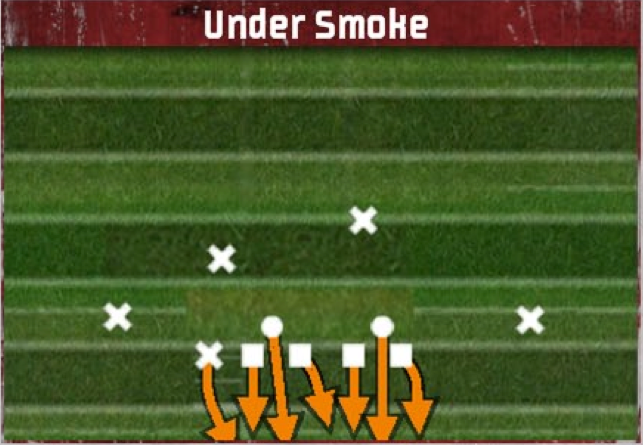
BULLETS - linebackers (Mike / Sam) blitzes
SMOKES - Safeties (Strong/Weak) edge blitzes
DOGS - Safeties & linebacker blitzes


The Bullets call, that involves the blitzing of both inside LBs through they're respective gaps, A of the Sam backer and B for the Mac backer. You can also send them into different gaps if you see fit. I.E.: The call “BULLETS A” would call for the Linebackers to blitz their respective “A” Gaps.


The next call is Thunder which tells the the Safety to the TE side that he’ll be blitzing from the outside. The next part of the call is 0 Cop. 0 is for the coverage, meaning all out man coverage with no safety help and the Cop Tag is a call used to tell the DE that he’ll have the TE in man to man coveage. TCU has very athletic DEs that allow them to be this creative on their blitzes. If you dont have athletic DEs I suggest using the LB Pass Rush package.


You can create this concept out of a number of looks from the 4-2-5, 4-3 and 4-4. I like to use for this concept out of Nickel Strong - Under Smoke.

Tuesday, July 6, 2010

Its been a long time.

I'll have some new stuff coming in the next couple of days. A large one dealing with Cover 1 "ROBBER" out of a number of different formations. BEST COVERAGE IN FOOTBALL.


Stay tuned,
Tez

Friday, May 28, 2010

Gap Control from the 3-3-5

With the reintroduction of Formation Subs into the next installment of the NCAA football series. I’ve been recently intrigued with the 3-5-3 defense. Its been the only thing I’ve been researching lately, seeing how I’ve exhausted every outlet trying to find something on the 4-4 “G” defense.

The 3-5 (or 3-3 Stack) is like the 3-4 on steroids. It gives you the ability to leave your opponent clueless on where the pass rush is coming from with 3 down linemen. You s necessarily need a “Jack” Linebacker, as the 3-4 employs. I like to employ a the first string SS and the other a OLB/SS hybrid, or a larger Safety type. Same theory as the “Jack” linebacker that is a DE/OLB thats a pure pass rusher that can play either standing up or with a hand in the dirt.

When I used the 3-3-5 in 10 the hardest thing for me was to stop the run. Luckily I found some good run fits verses people who try to bring the power run game to try to rip the 3-man line.

Gaining and Maintaining Gap Control

Typically, a 3-front defense is a two gap type of scheme. What that means is you're required to read and react to close the gap to the playside. You have keys in the offense, most notably the offensive linemen in front of you. If a guard pulls, he's going to bring you to the football the majority of the time. If the offensive lineman pass sets, you're probably going to rush the QB (unless a blitz is on, then responsibility CAN change to an occupier role). The truth is, they have to make a read and react. The nose, for example, will attack the center and slide into a gap as a play develops. Some of the best noses don't have to engage and react, they can react at the snap because they see what's going on. They are responsible for both A Gaps technically. In the game the key to improving your gap control is using slant stunts with you Defensive Linemen mixed in with blitzing Linebacker or two.

One Zone Blitz/Run Fit that I love to run is the Crash 3 Play from the Stack alignment.
The adjustment for this play is simple. Only thing you need to do is slant the line to towards the TE and user the blitzing linebacker.

Linebacker Pressures

Gap Pressures: Your LB’s must press the Open Gaps, You must know which gap is going to be vulnerable and blitz that gap with a LB, You can manipulate this by successfully manually blitzing, once your opponent decides to start shifting the line to the side that you’re blitzing from pulling a bait and switch and throwing in some F@G defense into the game should throw them off a bit. You also have to know which gap will be open for the LB. Recruiting wise for this defense your Mike LB is the anchor of your defense and needs to be a Ball Hawk. The defensive line movements and stunts are also important when it comes to the 3-3/3-5’s gap pressures and control. There are only 4 basic DL movements are available: Spread, Pinch, Crash right and Crash left. Adding a blitzing LB will also do wonders for your gap control on your run fits.


In sum, to play great run defense you must attack your assigned gap, shed blockers, pursue the ballcarrier, and make the tackle.This breakdown of gap pressures in the 3-3-5 should help you with understanding the plays that your calling and make you a better play caller.

Monday, May 10, 2010

Defending the Option

A lot of people are having problems defending the Option; be it the I-Form and Flexbone ‘s Triples and Load options, Shotgun ‘s Speed Options and the most dangerous shotgun running play of all, Air Force’s Shotgun Load Option. When NCAA 11 comes out things are not going to get easier (or so we suspect) with the Real Assignment AI blocking, will offer us “Optioneers” a chance to run these plays like they’re run in real life by optioning off the end man on the line of scrimmage or EMLOS. This becomes even more dangerous when plays like the Zone Read and Read Option are actually useful.
There are multiple ways to combat this. The most famous way is playing assignment football
TV analysts often refer to assignment football as a basic need for defenses playing the option. This refers to assigning defenders to each prong of the option. One (or more) defender(s) is assigned to the dive, the QB and the pitch.
Part of the assignment football philosophy is to switch these assignments among defenders in order to put pressure on blocking schemes.

Some common combinations of assignments:
Dive: defensive line
QB: MLB
Pitch: OLB
________________________________________
Dive: MLB and DT
QB: OLB and DE
Pitch: safety
________________________________________
Dive: MLB and defensive line
QB: safety
Pitch: OLB

Besides varying from play-to-play, these assignments will often change from the strong side to the weak side of the offensive formation.
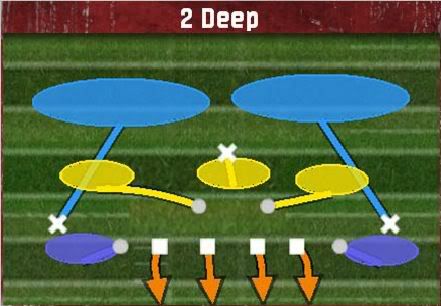
When using this philosophy, prefer the second set up. The D-Line will take the dive with support from the ILBs. The OLBs will take the QB with the Safety taking the Pitch. To build this, I use my base play out of my “G” defense, 4-4 – 2 Deep


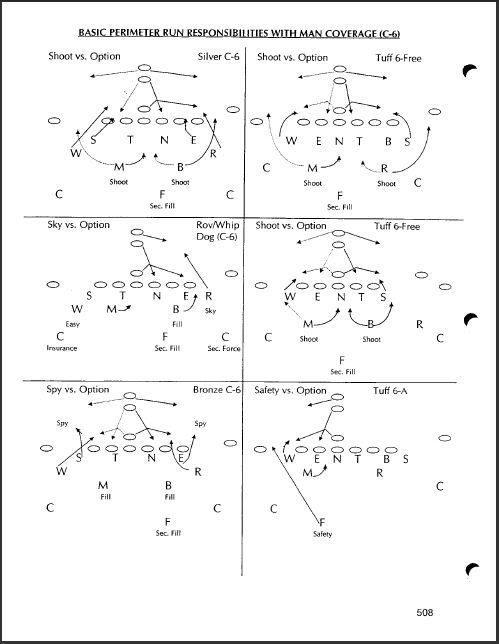
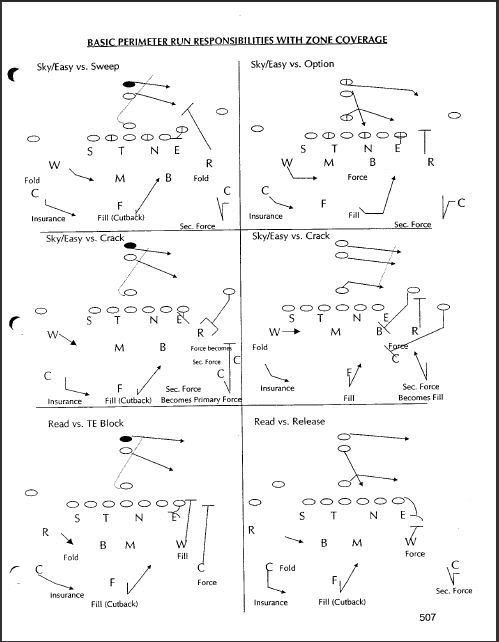
With the Option responsibilities show in the pictures below.


Adjustments
- Set Option Defense to Aggressive to a take the QB*
- Shift the D-line to the Field and Pinch them to handle the dive
- Hot Route OLBs to QB Spy
This play gives you coverage deep coverage, in case of a Option Pass, and puts the OLBs in the “Pitch Alley” You’ll have to user the FS to the play side to cover run support and the FS assignment on the Pitchman. If you played from the Flexbone, you may have seen a lot of your opponents take a Safety and run into the Pitch Alley to disrupt the pitch. Hot routing OLBs to QB Spy will allow them to follow the shadow the QB as he moves behind the line of scrimmage.

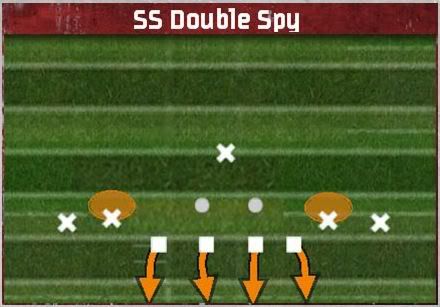
Another play I want to tell you about is a 4-2-5 Normal - SS Double Spy


Adjustments
- None
This play is good vs. your Flexbone - Quick Option/Ace Big – Speed Option types. User the FS to clean up the “pitch alley”. It’s a Cover 0 play, So I wouldn’t use it unless somebody is killing you over and over again with the Ace Big – Speed Option.

Another way to play the Option is letting the D-Line take the dive with support from the ILB farthest from the play side. If there is no dive the PSLB will play the QB and the OLB/Secondary will take the Pitchman. To build this I use the Nickel Strong – QB Contain play. (This play is also found in all the 4-3 alignments, but is global in the Nickel playbooks.)


Adjustments:
- Show blitz to walk a safety down into the box
- Spread the line
- Crash line in

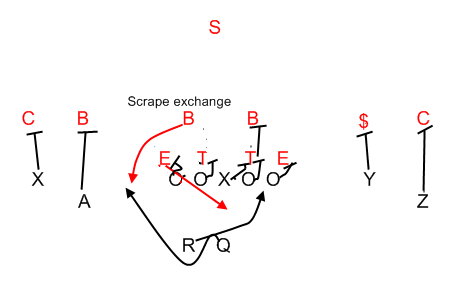
I prefer this set up verse shotgun option teams but it works verses under center option too. What this does is gives you a “Scrape Exchange” a real life technique that teams use verses teams that like to use variations of the Zone Read to go along with your Assignment Philosophy. With this defensive adjustment, the defensive end always crashes for the running back, while the linebacker “scrapes” over to take the quarterback. If the quarterback doesn’t see this, he will pull the ball, thinking he will have an easy lane on the backside, and instead runs straight into the linebacker.


SCRAPE EXCHANGE: PistolxCoach, at the utopia boards is the inspiration for this post as he is the one that gave me the set it up.
I would come out in 3-3-5 Split*, go All Out Blitz, pinch DL crash them in, spread LB's and contain the ILBs... leave the SS's alone that are blitzing, and user the FS... coach tight zone as well...

if that doesn’t help and he is getting outside... then run the same thing, but hot route the SS's to contain, and user the FS but spread the DL and crash them OUT...

either way should give him some fits to get started, and if you are expecting pass, use R1/RT and hot route LB's to hook zones/yellow... and hot route ONE of the SS's to hook as well so you’re still sending 5, dropping 6... I would do the zone audible to the FIELD just to be safe... meaning that if he is on the left hash, then hot route the SS on the right side of your screen, and you can even buzz zone him if he’s going flat... I would still coach tight zones...

...................................F.............. ....................................
.................................................. .....................................
.................................................. .....................................
.....C.......................LB...........LB....................................C.
...................$.............................. ...$................................
.........................B......E........T......E....................................
....................................... ().................................................

B = Line Backer
$ = SS

for added measure, if you’re good at hot routing, I would do what I described ABOVE... and if you have time, R1/RT and Right Stick LEFT to reblitz the LB playing DE so that his angle goes STRAIGHT UP field...


Great set ups, and hopefully with these tools you can stop the option.

Tuesday, March 2, 2010

4-4 "G" Write Up

Over at Utopia, I've posted my 4-4 "G" write up. While its not quite complete I do plan on the addition of videos and possibly updating the blitz packages and coverages before I put it into .PDF format.

Friday, February 19, 2010

Reading Offensive Tendencies

In order to play effective defense, you have to read your opponent's tendencies. Some plays that are great against some people are going to be garbage against others.

But in order to determine what will work, you need to figure out your opponent's Tendencies.


Where does your opponent throw the ball when he has time?

Does he hit the seams? If so, you may want to move LB's overtop of the TE (or slot receiver) and maybe even man him up.

Does he go for the corners? If so, you may want to consider more buzz (purple) zones.

Does he use 10-yard curls? Purple zones and outside hook zones will help with this. Be sure to bump as well.

Does he use a deep post to get behind your coverage? Make it a habit to play with your coverage to help throw off his reads to prevent this.


Does your opponent like to roll out? If so, what side does he favor?

This will help you determine where to send pressure from, how to blitz your linemen, etc.


Where does your opponent throw when under pressure?

Will he throw to the shallow middle? If so, use more plays that have 2-3 guys in the middle with hook zones in the default play art.

Will he go to the flats? Corners in flat zones are great for this.


Does he use unbalanced formations often?

If so, make sure you have purple zones on that side. He will likely set up a route combo to that side.


How often does he use screens?

Try to figure out what formations he uses and who the screen goes to. Some people will roll way out to the opposite side. Stop chasing him and read the screen. I see a lot of people run HB Screens out of Shotgun and Singleback sets. If they’re in the Shotgun formations I always manually blitz from the that the HB is on, If I see him stop I’ll recover from my blitzing with the OLB/SS and recover to shut down the screen. As far as WR Screens go, a 2 deep coverage with man coverage under is the way to go.


Can your opponent run out of Shotgun?

This will determine if you can safely move guys out of the box when he's in Shotgun.


Does he use compressed sets?

Remember to move your flats zones out a little if he does. Compressed sets will enable him to throw quick slant-outs if you don't do this. And use buzz zones only to the boundary-side to better control zone holes.


Does your opponent do better against max coverage, or pressure?

Some people are great against the blitz, but are terrible when seeing F@G D. Others rely on having time to throw and will take some sacks. And some people are good against both. Figure out what is more successful and lean more towards that.

(H/T: Michura over at the Madden Boards)

Wednesday, February 3, 2010

Study Notes

- Option Routes I recently found a video on Youtube by DjWill on Option Routes, If you're anything like me and didn't use them at all the following information will change your whole outlook on the routes. Option routes give your WR a chance to read the coverage and find holes in the defense. Best ran against a zone defense, they were a staple of the Run N' Shoot offense and have branched out to other offense.

I remember reading somewhere that either Tiger Ellison or Mouse Davis came up with the concept while watching some kids playing a game of football in the backyard. And while playing the game you kinda have to treat the route as such.

Most option routes are built with 2 or 3 options. All should be able to defeat Cover 0/1/2/3 and some times Cover 4. Throwing to the option route can be dangerous if you dont know what direction the route is going and when the break will be made. Which is why it's important to have a knowledge of all the options the WR has. It's also imperative to have WRs with high AWR at least in the mid to high 80's. This will give them a better chance to make the correct reads and decision and get in the holes between zones.

(Blogger is kicking my butt and not letting me add the video here so...)
video linkage

- Basic Theory for Pass Defense Rhombic is definitely on it in this post for over on the Utopia boards. Who mathematically breaks down the theory of Pass defense with graphs? RHOMBIC! Great read, definitely worth checking out.

- BROPHY I've been reading some old post from Brophy as of late, And maybe I shouldn't do this, cause it makes me want more from EA development team. But he breaks down Saban's Defense in 3 post and also breaksdown concepts that would definately make you a better play caller on defense such as AFC Automatic Front Check and Formation Matching which have really became a HUGE part of my defensive play calling and has made me change my audible several times as of late.

Definately good reads.