Saturday, October 16, 2010

4-2-5 Split Field Coverage Pt.1

Oneback has already explained how to use the "ROBBER" scheme to perfection. What I want to show you is how to adapt this to 2x2 sets and 3x1 sets and introduce you to SPLIT FIELD COVERAGE, a schemes that TCU and other 4-2-5 teams use.

TCU teaches their secondary to divide their formations down the middle of the field and after you do that to each side there’s only 3 Formations that the offense can give you.

FORMATIONS
  • Pro - TE and WR to one side
  • Twins - Two  WRs to one side
  • Trips variations 


(with the addition of Quads that adds a new wrinkle which I’ll get to in a separate post)


4-2-5 Cover 3 will be your base play just as Oneback stated in his Robber description. The Read side, will of course, be the Trips side. Vs any 3x1 formation you want to shift your LB over towards the trips side to wall off the first thing that comes inside. You’ll also want to Shift the coverage to the Trips side. This gives you close variation to Quarter/Quarter/Half Coverage.  You’ll also want to take that read side SS and put him a Buzz zone to handle everything outside the hash and it keeps him in place to handle run support.


In this coverage I personally user the FS and run the same Robber Rules with him and try to handle anything that threatens the inside. The SS in the Buzz zone handles anything that goes to the outside of the hash leaving the C to continue his dropback to handle anything deep. With the FS you, seriously, have to follow the ROBBER rules or the Middle is open. Remember that if the inner most reciever runs a shallow the responsibilty for him is passed off to the LBers in hook zones, and you have to gain depth with the FS and look for the backside post.

Weakness:
Screens

Summary
Base Play: 4-2-5 Cover 3
Adjustments:

  • Shift LBs and Coverage toward the Trips side.
  • Hot Route the Trips side safety to Buzz Zone.
  • Align FS over the inside most threat

Proper Alignment is very important vs trips sets.

(H/t to Brophyfootball.blogspot and RunCODHit.blogspot for inspiring this and the next series of updates)

Sunday, October 3, 2010

How To Play "ROBBER" Coverage

Thanks to Oneback over at Utopia, I didn't know anything about Robber Coverage until he explained to me how to run it, I've had a massive hard-on for the coverage every since. Be it Cover 1 Robber, 2 Deep Robber or the Hook Zone in a Cover 3 play. This has revolutionized the way I play defense.

Pre-snap the free safety will align to the passing strength of the formation, if #2 is a tight end he will align on the outside shoulder and eight yards deep, if #2 is a wide receiver he will align on the outside shoulder of the offensive tackle and eight yards deep.

After the snap he will read the quarterback for run/pass key, once he reads pass he will focus on #2s route.


If #2 runs a vertical route you will have him in man-to-man coverage to the inside, depending on the route of #1 the free safety may have outside help by the cornerback.


If #2 runs an arrow or quick out route the free safety must widen with #2 while keying #1.


The free safety must get underneath #1 and be alert for a pass to rob the pass.


If at the snap of the ball #2 runs a shallow cross the free safety must open to #1 gaining depth and width.


Be alert to a backside post route by the backside #1 or a seam by the backside #2.


If there is no backside deep threat, rob strong side #1.

If #2 runs a deep out key #1.


Alert post or deep outside route by #1, play underneath #1 with corner over the top to rob the pass.


If #2 runs a dig route in real life the free safety would jump the route to the inside and attempt to intercept the pass. However, due to the fact linebackers in coverage have the ability to sense routes being run behind them I typically fall back into deep middle coverage.


Look to the strong side #1 to ensure he is not running a post route then look to the backside for a deep threat.


With a #2 dig route the free safety will typically play inside of the deep threat to either side with the corner to the outside.

The ability to play effective robber coverage will force the offense to throw deep to the outside or underneath as the defense will take away the easier throws over the middle that most offenses look to complete.

Wednesday, September 22, 2010

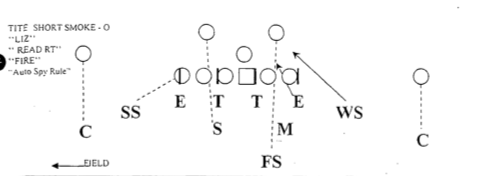
TCU's Tite Short Smoke 0 Blitz

Formation: 425 Under (if the ball is on the left hash)
425 Over (if on the right hash)

Base Play: Crash Gold


This is a awesome pressure play to use when the ball is on the hash, a good change up play since most 4-2-5 like to use zones because of deficiencies with man coverage. If you're familiar with my philosophy on how to use the 4-2-5, I dont use the base plays vs Trips 4 and 5 wide unless I chose to dail up some type of blitz. If you call this play, and your opponent audibles into a Trips play, its a pretty good idea to have Nickle Strong Cover 1 "Robber' in your audibles.

Play Setup:
Again, this is a hash blitz. The "Tite" Call is telling you to set your 3 tech DT away from the TE, hence, the Under/Over formations. The Over Formation gives you a 1 Tech Nose Guard and a 3 Tech DT, while the Under is the exact opposite. The "Short Smoke" Call, tells your SS/OLB that he's blitzing from the boundary.

Optional Adjustments:
- Back off coverage so to not get beat by the deep bomb
- Set the blitzing ILB to Spy as this helps against the inside run and doesnt leave a huge cutback lane that can open if you leave him set to blitz.

Thursday, August 26, 2010

Bear Front Defenses


While many of you are aware of the Bear Front defenses in you defensive playbooks, the majority don't use it because of your lack of understanding of the scheme behind it.Every defensive package should have some sort of Bear Front in its package it is set up. The 4-2-5 and 3-3-5 have a version based off the 46 (pronounced “forty-six” not “Four-Six)Defense that was designed in the early 1980s by Buddy Ryan with the Chicago Bears. Most folks know that – and hence, the nickname, “Bear” Defense. It was the defense of the dominant 1985 Bears team. This is also the front used in Arizona’s “Desert Swarm defense back in the day and the same defense that Army is using today (A mixture of the 3-4 and 3-3-5).

The defense has its basis in the old 5-2 Double Eagle front and is easy to stem in and out of from your base defenses. It is an 8-man, run-stopping front that works well with man coverages and with Cover 3.


Alignment


The alignment of the Bear Defense revolves around the 3-0-3 alignment in the middle. This means we have a Defensive Lineman aligned on the outside shoulder of each of the Guards, and a head up Nose Guard. The biggest advantage of this front is its almost impossible to create double teams, especially on your Nose Guard.

The weak side Defensive End stays in a 5-Technique. On the strong side, one Linebacker/SS is going to walk up on the inside foot of the Tight End while another Linebacker or Safety is going to walk up on the outside foot of the Tight End. Whoever is doing this is going to be based on the Defensive playbook, so don’t get caught up in the letters.

Run Fits

There’s no better front for stopping the run than the Bear. The 3-0-3 techniques are great for stuffing runs up the middle and forces your opponent to take runs to the outside. This, by design, the contain players on the perimeter will make or break if this defense works for you or not. If they don't keep a proper contain on the perimeter you’re going to be open to the outside run play all day, so you definately have to be careful with your play selection.

There are all sorts of Run fits in these playbooks. Cover 1 Plug from the 46 Bear, Storm Read from the 3-3-5 Bear, and the MLB Blitz from the 4-2-5 Bear.

Coverages

As mentioned, the coverage for the Bear Front Defense is mostly going to be Cover 0, Cover 1 or Cover 3 – which should be the case with any 8-man front defense, unless you’re running the 3-3-5 Bear version which is the only Bear Front that offers a Cover 2 “Robber” (which you already know Im a fan of) in the Spy 2 Blitz play and my personal opinion is that it should be in every bear front scheme. )That’s going to be the basic look.

You can get creative with your coverages in any defensive front, but the reality is, you are limited in coverages with the 46 Defense. Bear defense coverages are pretty well limited to Cover 0, Cover 1, and Cover 3.

Cover 1

The primary Bear Defense coverage is the Cover 1, with man coverage and one safety helping over the top. This allows a 4 to 5 man rush on the QB.

4-2-5 offers 3 versions of Cover 1. One that I like to play with is QB contain. Sometimes I decide to make adjustments to this play (IE Canceling out the contain) but I usually get a good amount of pressure with it on verses a user that knows how to use the option playbooks.

CB Fire 1 is a great play to use on passing downs when the ball is on the hash. I personally like to send corner blitzes on from the boundary (short) side of the field. Many people think they are useless plays and twice as many never expect them.

Cover 0

The next coverage for the Bear Defense is a Cover 0, Man Coverage with no help over top and a 6 man rush. All 6 players lined up on the line will rush, with the Free Safety taking the Tight End or the Halfback. If you've shown a lot of Zone plays from the Bear, try mixing in some Cover 0

4-2-5 plays:
MLB Blitz and Strong Safety Fire

3-3-5 plays:
Monster Green, Fire Green and Middle Plug

Cover 3

Finally, the Cover 3 is the natural fit for zone coverage in the Bear Defense.

The Free Safety and the two Corners handle the deep 1/3′s, which is pretty standard in Cover 3.

You have the option of making this a 4 under, 3 deep coverage with a 4 man rush or a 3 under, 3 deep coverage more closely associated with Fire Zone blitzes and 5 man pressure. How you want to create the 3 under, 3 deep (or any zone coverage out of the Bear Defense) is going to depend on your personnel. You may not have an End who can drop off, so you’d need to adapt.

Thoughts on Coverages
The Bear Defense is an attack-style defense. It is for causing havoc in the backfield. Man coverage is best for quick throws, because your guys are playing closer to the receivers.

If you’re going to run the Bear Defense, you need to be forcing quick throws with heavy pressure from the guys on the defensive front.

Strengthening Your Bear Front

I suggest building a stronger line for something like this by Formation Subbing. Making sure that your largest and best tackle is at Nose and, depending on what base defense your using, that your 3tech players are Tackles too. I also experimented with adding a 4-4 and 3-5-3 personnel to these packages in these playbook and had pretty good results. The fact that the Bear coverage scheme is mostly Man coverage, the only plays you have to be careful of is Cover 2 Man when using the same formation subs.

(H/t to DrB at http://www.shakinthesouthland.com/ and Coach Joe Danienl at http://www.football-defense.com/)

Tuesday, August 10, 2010

Spread Offense Manual from 09

Been going through this recently. Very well thought out and the principles still hold true...

Spread Option Manual v 1.1

Friday, August 6, 2010

Employing TCU's Bullets Thunder 0 Cop Blitz

I’ve been doing a lot of reading on the 4-2-5/4-4 defense, defenses in general. I recently ran across a post over at Blitzolgy about TCU’s Bullets Thunder 0 Cop Concept. Oneback has already described in his guide the basic calls TCU uses on defense out of their 4-2-5:

BULLETS - linebackers (Mike / Sam) blitzes
SMOKES - Safeties (Strong/Weak) edge blitzes
DOGS - Safeties & linebacker blitzes


The Bullets call, that involves the blitzing of both inside LBs through they're respective gaps, A of the Sam backer and B for the Mac backer. You can also send them into different gaps if you see fit. I.E.: The call “BULLETS A” would call for the Linebackers to blitz their respective “A” Gaps.


The next call is Thunder which tells the the Safety to the TE side that he’ll be blitzing from the outside. The next part of the call is 0 Cop. 0 is for the coverage, meaning all out man coverage with no safety help and the Cop Tag is a call used to tell the DE that he’ll have the TE in man to man coveage. TCU has very athletic DEs that allow them to be this creative on their blitzes. If you dont have athletic DEs I suggest using the LB Pass Rush package.


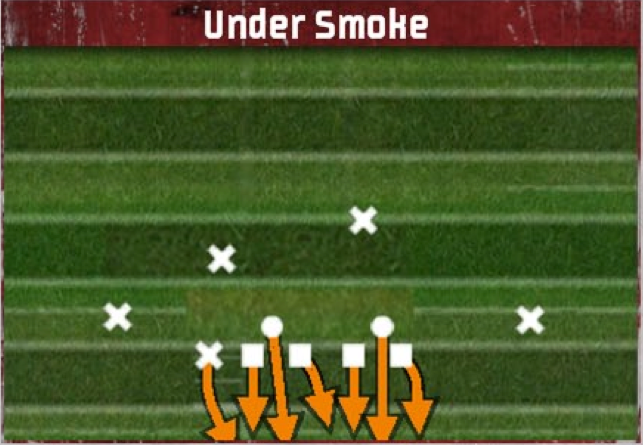
You can create this concept out of a number of looks from the 4-2-5, 4-3 and 4-4. I like to use for this concept out of Nickel Strong - Under Smoke.

Tuesday, July 6, 2010

Its been a long time.

I'll have some new stuff coming in the next couple of days. A large one dealing with Cover 1 "ROBBER" out of a number of different formations. BEST COVERAGE IN FOOTBALL.


Stay tuned,
Tez